
Curtain, Blind & Shade Installation in Dallas
A curtain rod looks like a ten-minute job until the anchor pulls out of the drywall six weeks later and takes a chunk of wall with it. Most of what goes wrong with window treatments is the anchor, the height, or the span — and all three get decided before anything goes on the wall.
You buy the rods, blinds and shades you want. We put them up level, anchored for the weight they're actually carrying.
What We Install
- Curtain rods and drapery hardware — single and double rods, returns, finials, tiebacks, brackets
- Blinds and shades — faux wood, aluminum, roller, roman and cellular, inside or outside mount
- Motorized and smart shades — battery and hardwired, paired to the remote, app or hub
- Long spans and bay windows — center supports where the rod needs them, corner connectors on bays
- Replacements — old hardware off, new hardware up, existing holes dealt with
Height and Width: Where Most Curtain Jobs Go Wrong
Two measurements do most of the work, and neither is where people instinctively put the rod.
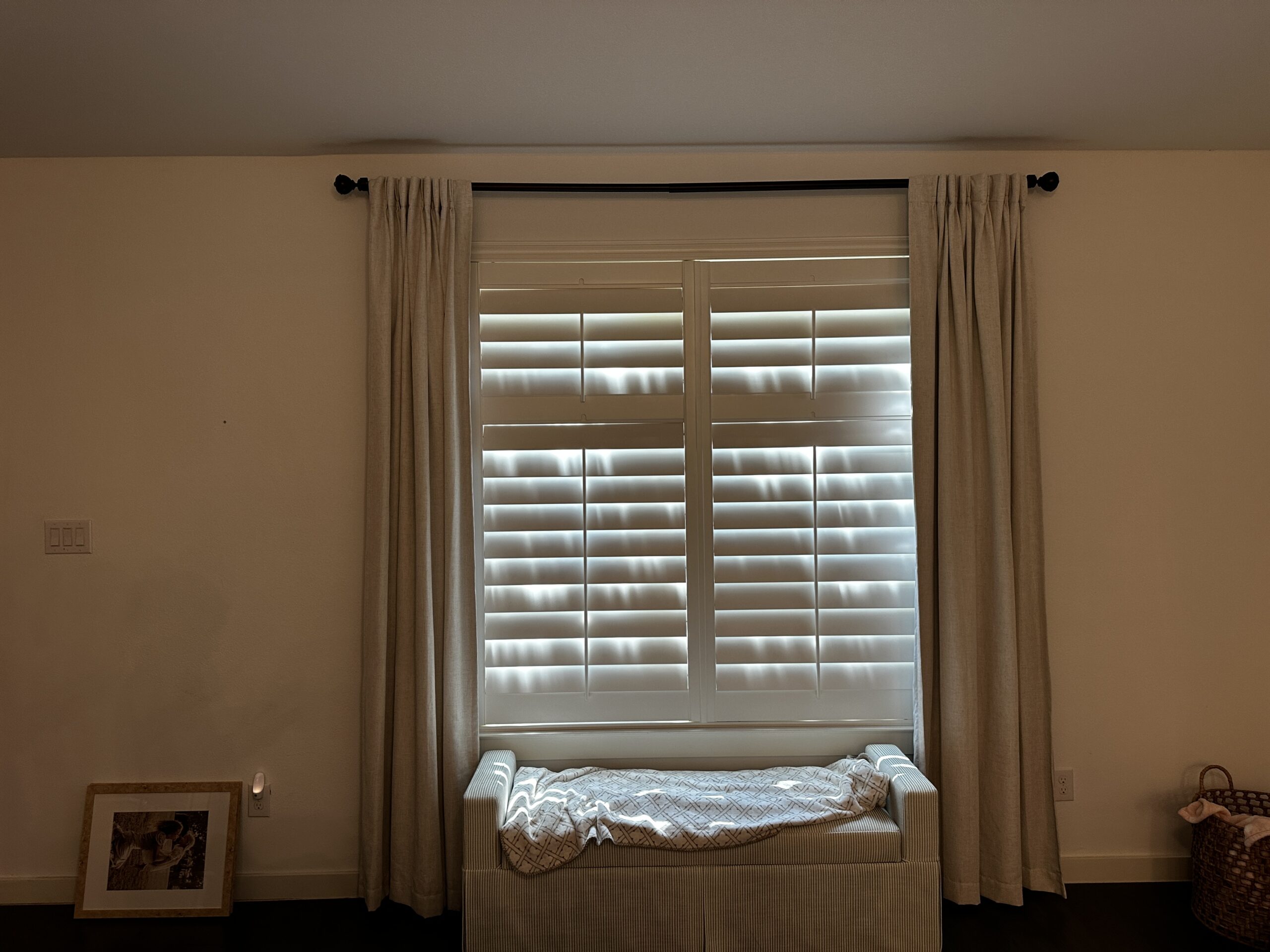
Height. The rod goes four to six inches above the window casing, not on it. Higher draws the eye up and makes the window read taller. In a room with tall ceilings you can go further — some rooms take the rod just under the crown.
Width. The rod extends eight to twelve inches past the casing on each side. That lets the curtains stack off the glass when they're open, so you keep the full window and the whole room gets the light.
Get those two wrong and it doesn't matter how good the curtains are — the window looks small and the room looks dim.
The Anchor Is The Whole Job
What's behind the wall decides what holds. This is the part that gets skipped.
Drywall with no stud where you need one. Toggle bolts, not the plastic sleeves that come in the box. A pair of lined curtains on a wide rod is heavier than people expect, and it pulls down and out at the same time — the worst direction for a cheap anchor.
Plaster and lath. Common in the older Park Cities, Lakewood and East Dallas houses. Plaster cracks if you drive into it without pre-drilling, and the repair costs more than the rod. Slower, different bit, different anchor.
Metal studs. Turn up in newer construction and in some converted spaces. A wood screw does almost nothing in one; it needs the right fastener.
Tile and stone. Bathroom and kitchen windows. Drilled with the right bit, into the grout line where that works, and never rushed — a cracked tile is a much bigger repair than the job you came for.
Brick and masonry. Sunrooms and patio doors. Different anchor again.
Blinds: Inside Mount or Outside Mount
Inside mount sits in the window recess and looks cleaner, but only works if the frame is deep enough for the headrail and the window is close to square. Older Dallas houses are frequently neither.
Outside mount goes on the wall or the casing above the window. It covers more, blocks more light at the edges, and is the answer when the recess is too shallow or the opening is out of square.
If you're ordering and not sure which you've got, measure the depth of the recess before you buy. That number decides it.
Motorized and Smart Shades
We install battery and hardwired motorized shades, hang them, and get them working — paired to the remote, joined to your wi-fi, and added to your hub or app if that's how you're running things.
Worth knowing before you order: hardwired shades need power at the window. If there's no outlet up there, that's an electrician's job before ours, and battery is usually the simpler answer for a retrofit.
You buy it, we hang it
We install what you've chosen. We don't sell hardware, pick it out, or measure for your order — you'll get a better price buying it yourself anyway.
The one thing worth being careful about: measure before you order. Blinds cut to the wrong width can't be made to fit, and a rod that's too short for the window can't be stretched. If what arrives doesn't fit the opening, we can't install it, and that's a wasted trip for both of us. Width, height and recess depth, written down before you click buy.
How much does curtain and blind installation cost in Dallas?
Curtain and blind installation starts at $120 for labor. You supply the rods, blinds or shades. What moves the price:
- How many windows are in the job
- Motorized or smart shades
- Plaster, brick, stone or tile around the window
Send photos and the number of windows and we can usually quote without a visit.
I shortened "you supply the hardware" to one sentence, because the "You buy it, we hang it" section just above already explains it.
Common Questions
How much does it cost to have curtains or blinds installed in Dallas?
Curtain and blind installation starts at $120 for labor. A single rod in drywall is quick; six windows of blinds, motorized shades, or anything going into plaster or tile takes longer and costs more. You supply the hardware. Send photos and the number of windows and we'll give you a real number before anyone comes out.
Do you supply the curtains, rods or blinds?
No. You choose and buy them, we install them. You'll get a better price and exactly the look you want, and we're not marking up hardware.
Can you hang curtains on plaster walls?
Yes. Plaster needs pre-drilling and different anchors than drywall, which takes longer but avoids the cracking that makes a small job into a wall repair. Plenty of the older houses we work in are plaster.
Can you install motorized or smart shades?
Yes, battery and hardwired. We'll hang them and set them up with the remote or app. If a hardwired shade needs power run to the window, that part is electrical work and needs an electrician first.
Got a job on the list?
Send a few photos and I can usually quote the same day.

Fixing what's bugging you
Owner-operated handyman serving Dallas and nearby cities. I'm on every job.
Service Area
Dallas, University Park, Highland Park, Farmers Branch, Addison, Carrollton, Coppell, Garland, Irving, Plano and Richardson
Hours
Every Day, 8am to 5pm
© 2026 Dallas Elite Home Services